
The acronym EMEA appears in annual reports, job listings and sales dashboards at most international companies. It refers to a group of markets covering Europe, the Middle East and Africa, and is used to organize teams, allocate budgets or manage marketing campaigns. This grouping has no legal or institutional status: it is a management convention whose exact scope varies from one company to another.
EMEA scope in a report or dashboard: why country lists differ
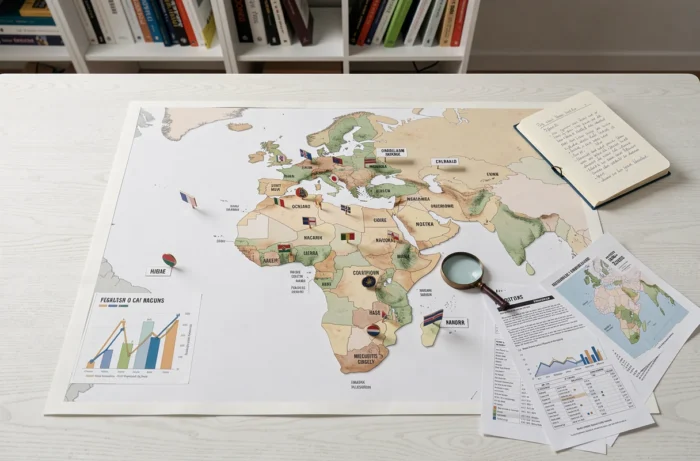
EMEA stands for Europe, Middle East and Africa. Beyond this definition, the region’s actual makeup depends on the organization using it. An analytics software provider such as Adjust automatically assigns each country to a sales region and refers to a country-by-country mapping table. One multinational industrial company may include Turkey in its EMEA scope, while another groups it with Asia-Pacific.
This lack of a single standard has a direct consequence: comparing EMEA figures from two sources requires checking their scope country by country. A report showing a certain percentage of EMEA growth cannot be meaningfully compared with another if the two cover different territories. Whenever you encounter regional data labeled EMEA, make a habit of looking for the underlying country list.
To learn more about what the EMEA region means and its practical implications, remember that the label masks a patchwork of markets with very different realities.

EMEA, APAC, the Americas: how companies divide up the world
The EMEA grouping is part of a common three-region model. Large companies divide their global operations into three main blocs:
- EMEA: Europe, the Middle East and Africa, covering time zones from the eastern Atlantic to the western Indian Ocean.
- APAC (Asia-Pacific): from India or Pakistan to Australia and New Zealand, including Southeast Asia and the Far East.
- The Americas: North America, Central America and South America, sometimes split into NA (North America) and LATAM (Latin America).
This three-region model exists because a traditional continental division (five or six continents) does not reflect operational realities. Grouping Europe and Africa together may seem counterintuitive culturally, but their proximity in time zones makes it easier to coordinate sales and support teams.
Each bloc can then be divided into subregions. EMEA is sometimes split into Western Europe, Eastern Europe, the Middle East and sub-Saharan Africa. Again, there is no shared standard for the boundaries of these subregions.
EMEA job listings: what the scope means for a role
In international recruitment, the terms “EMEA role” or “EMEA manager” indicate a scope of work that could range from managing a few European countries to overseeing markets across three continents. An EMEA sales director based in Paris faces different time-zone, regulatory and language challenges from an APAC counterpart based in Singapore.
Checking which countries the role covers is essential before applying. Some companies use EMEA as a synonym for Western Europe plus a few Middle Eastern markets. Others include all of Africa, which can dramatically change the workload, expected travel and language skills required.
Common edge cases in EMEA scopes
Several countries regularly fall on the boundary between two regions. Russia, Israel, Turkey and Kazakhstan may be assigned to different blocs depending on the company. Some analytics platforms classify Afghanistan as EMEA, while others place it in APAC. These edge cases are not trivial: they affect how data is interpreted and how sales responsibilities are allocated.
Regulatory diversity across EMEA: the example of the European AI Act
The single EMEA label encompasses legal frameworks that have little in common. The European Union’s Artificial Intelligence Act is a clear example: some of its provisions have applied since February 2, 2025, while others are being phased in according to a later timetable. The Act applies only to EU countries and, to some extent, to companies that market their products there.
A global EMEA report aggregating data on AI adoption will therefore lump together European markets subject to the Act and African or Middle Eastern markets that are not. The region’s name says nothing about the actual legal obligations in each country.
Due diligence rules for value chains illustrate the same point. The obligations of a company operating in EMEA depend on its activities, size and the countries involved—not on its membership in a regional bloc. European compliance deadlines may themselves be revised after legislation is adopted, making the picture even more complicated.
Check the scope before interpreting the data
When reviewing a document labeled EMEA, check three things:
- The exact list of countries included, available in the appendix or the report’s methodology.
- The regulatory framework applicable in each subregion, which may affect how the figures presented should be interpreted.
- When the scope was last updated, since countries may be added or removed from one year to the next.
An EMEA figure without its country mapping table is incomplete. This precaution applies to financial reports as well as marketing dashboards and industry studies.
The EMEA region remains a useful management tool for coordinating teams across nearby time zones. Its main limitation is that it suggests a degree of uniformity that does not exist. Whenever the acronym appears in a document, the first question to ask is what the exact scope is, country by country, and which rules actually apply there.