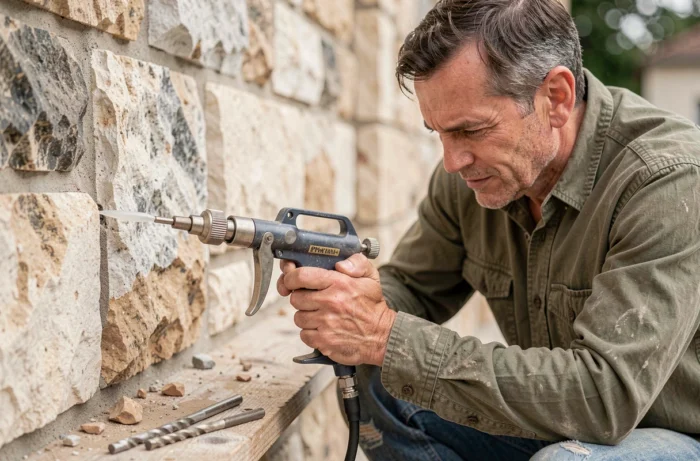
Fixing a metal plate to a limestone wall, anchoring a wooden post in a concrete slab, sealing a steel guardrail on a granite threshold: each combination of materials imposes its own constraints. Chemical anchoring addresses these situations, but its success depends less on the chosen resin than on the preparation of the substrate. Here’s how to practically approach each case.
Substrate Preparation: The Factor That Resin Cannot Compensate For
This step is often underestimated because it seems obvious. In practice, the majority of failed anchorings come from poorly prepared substrates, not from a bad product.
On metal, the surface must be degreased and free of any signs of oxidation. A slightly rusty or greasy threaded rod prevents the mechanical adhesion of the resin. A wipe with acetone or industrial degreaser, followed by brushing, is sufficient in most cases.
On wood, the problem is different. Treated or varnished wood has a surface film that repels the resin. It is necessary to sand the contact area and remove all dust before injection. Wet wood also poses a real problem: some polyester formulations do not polymerize correctly in humid environments, whereas epoxy resins tolerate these conditions better.
To use chemical anchoring on wood, metal, or natural stone, the preparation is therefore adapted to each material even before considering drilling or choosing a cartridge.
On natural stone, porosity changes everything. A soft limestone absorbs the resin like a sponge, which dilutes the fixation. A dense granite, on the other hand, offers little mechanical grip. In both cases, blowing out the hole with a compressor (or with a bulb if necessary) is essential to remove drilling dust that would create a film between the resin and the wall.
Chemical Anchoring on Natural Stone: Sieve, Resin, and Porosity
Natural stone is the substrate that generates the most questions because you never know exactly what you will find when drilling. A wall made of rubble may contain hard stone, friable lime mortar, and pockets of air, sometimes all in the same alignment.
The injection sieve becomes almost mandatory on irregular stone. Without it, the resin leaks into cavities or porous joints and never forms the necessary mass around the rod. You drill to the diameter of the sieve (often wider than the standard drilling), insert the sieve, and then inject the resin through it.
The choice of resin is as important as the method. On limestone or tuff, a vinylester or styrene-free epoxy resin is preferred, as it does not stain the substrate and better resists capillary moisture. Standard polyester resins work on hard and dry stone, but their compatibility decreases on soft or wet stones.
- Hard stone (granite, compact sandstone): polyester or vinylester resin, drilling to standard diameter, sieve optional if the stone is homogeneous
- Soft stone (limestone, tuff, friable millstone): vinylester or epoxy resin, systematic sieve, enlarged drilling to accommodate the sieve
- Rubble wall with earth or lime joints: sieve mandatory, epoxy resin to maximize adhesion on irregular surfaces, increased anchoring depth
Epoxy or Vinylester Resin: Choose According to the Substrate and Environment
The type of resin is not a cosmetic detail. Each chemical base behaves differently depending on the material and application conditions.
Epoxy offers the best adhesion on metal and on smooth or wet substrates. Its polymerization is slower (several hours depending on the temperature), which allows time to adjust the positioning of a metal part. On the other hand, it cannot be loaded quickly.
Vinylester resin represents a good compromise for most common uses on stone and concrete. It polymerizes faster than epoxy, performs well in humid environments, and generally does not contain styrene, which avoids staining issues on exposed stone.
Polyester remains the cheapest solution, suitable for indoor fixings on solid and dry materials. On wood or metal exposed to the outdoors, feedback varies on this point, but detachments are regularly observed after a few freeze-thaw cycles.
Chemical Anchoring on Wood and Metal: Injection Technique and Common Mistakes
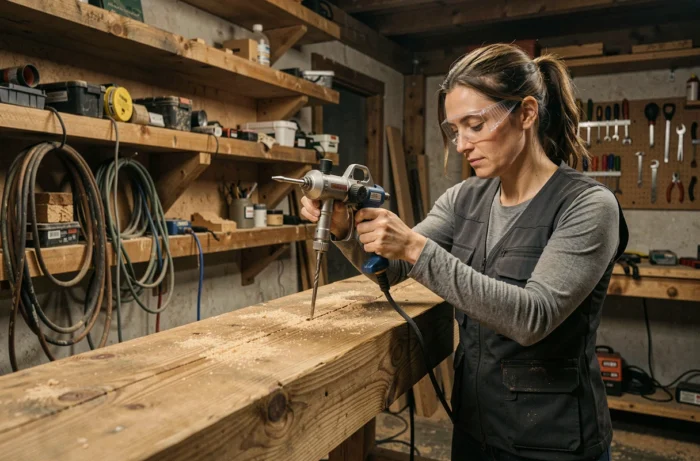
On wood, a threaded rod is not anchored in the same way as in masonry. Wood moves, swells, and contracts. The drilling must be slightly oversized to leave a sufficient volume of resin around the rod and compensate for the material’s movements.
The hole is filled two-thirds full before inserting the rod while slightly turning it. The excess resin that rises confirms that the filling is correct. If nothing rises, the injected volume is insufficient.
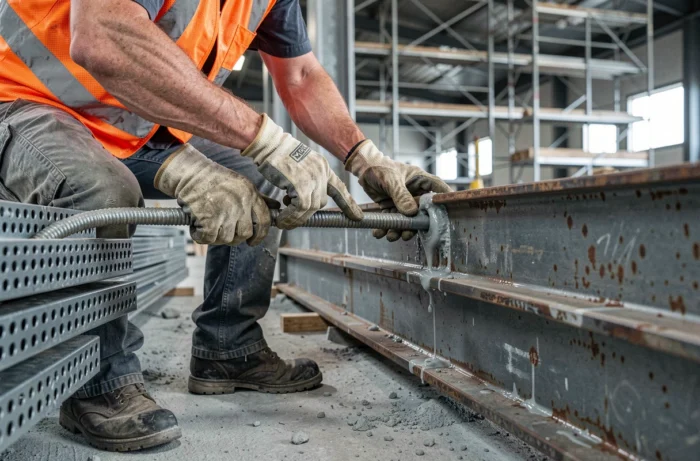
On metal, the typical situation involves anchoring a threaded rod in concrete or stone, then bolting the metal part on top. The resin is not in direct contact with the metal in this case. When metal needs to be bonded to metal or metal to wood, a two-component epoxy putty is preferred over a standard chemical anchoring cartridge.
- Clean and degrease all metal surfaces before application
- Sand treated or varnished wood in the contact area
- Always blow out the drilling hole before injection
- Respect the full polymerization time before loading, even if the resin feels hard to the touch
Polymerization Time and Loading
Ambient temperature directly influences the curing time. Below ten degrees, polymerization can double or even triple. Applying a load too early remains the most common mistake on site, especially in cold periods.
Check the technical data sheet of the cartridge to know the setting time at the day’s temperature. This data varies significantly from one manufacturer to another and from one chemical base to another. For a structural fixing (guardrail, wall bracket, post plate), it is better to wait beyond the minimum time indicated.
Chemical anchoring is not a universal glue. Its reliability relies on three parameters that must be mastered even before opening the cartridge: a clean substrate, appropriate drilling, and a resin compatible with the material and site conditions. The rest is mechanics.