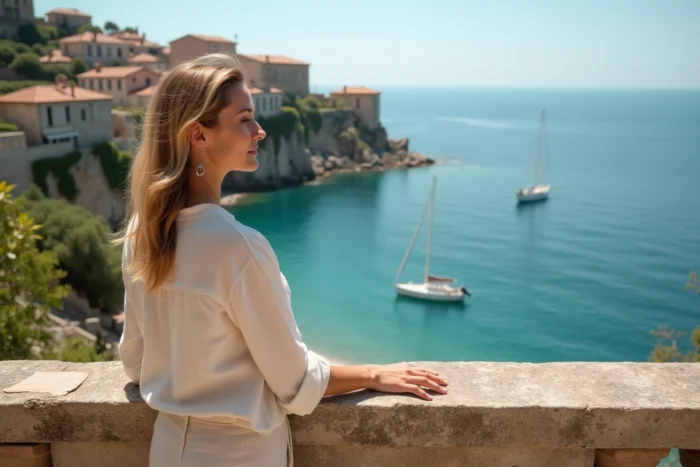
The French coastline attracts new residents each year seeking quality of life. Choosing the best destinations to live by the sea in France requires considering several often-overlooked criteria: stability of the coastline, actual prices per square meter, and economic dynamism outside the tourist season.
Coastal erosion and retreat of the coastline: a filter to integrate before any purchase
The quality of life, shops, and weather are included in all rankings of coastal cities. However, erosion conditions the long-term viability of a settlement project and is rarely taken into account.
The state estimates that 20,000 km of the French coastline are exposed to erosion and that 30 km² of land have disappeared in fifty years due to the retreat of the coastline. On the Petit Nice beach in Gironde, the retreat has reached 60 meters in five years.
Coastal municipalities are now required to integrate adaptation into their urban planning documents. Exposed areas must be identified, prioritized, and then arbitrated according to protection or relocation scenarios. A property located in a risk zone may see its value weakened or even become unbuildable over time. Inquiring about a municipality’s coastal risk prevention plan is a prerequisite that many prospective residents overlook.
The question of where to live by the sea in France should therefore be posed with this geophysical filter in mind, even before comparing prices or sunshine.
Real estate prices by the sea: disparities that redraw the map
The coastal real estate market does not form a homogeneous block. The rise in prices has generally slowed in recent months, but the disparities between coastlines remain considerable.
Over three years, prices in seaside resorts have increased by 13.3%, while the national market declined by 3.9% during the same period. The average price to acquire a property in a coastal municipality is around 4,888 euros per square meter, compared to 3,108 euros on a national average.
Accessible coastlines and pressured coastlines
Not all coastlines are equal in terms of budget. The most affordable areas are concentrated in:
- Charente-Maritime and Gironde (excluding Arcachon), where towns like Royan maintain prices significantly lower than the Basque coast
- The Normandy coastline, with municipalities like Fécamp or Dieppe offering access to the sea at prices close to the national average
- Southern Brittany, particularly Lorient, which combines reasonable prices with an active job market
In contrast, the Basque coast shows very high levels. In Biarritz, the median price far exceeds the coastal average, and demand remains strong despite the general slowdown. The Mediterranean coastline also presents higher prices, with marked disparities between large urban areas (Montpellier, Marseille) and more modest resorts.
Living year-round on the coastline: employment, services, and seasonality
A common trap is choosing a holiday destination as a primary residence. The winter reality of certain seaside resorts differs radically from their summer face: closed shops, reduced medical services, limited transportation.
The cities that truly function year-round share some common characteristics:
- A diverse job market, not solely tourist-based (La Rochelle with its port and industries, Lorient with fishing and naval, Brest with research and defense)
- A transportation network connected to the national network (TGV, highways, regional airport)
- Health, education, and cultural facilities open twelve months a year
The pressure from tourist rentals complicates matters as well. In some coastal areas, the supply of tourist rentals has surged by 118% between 2020 and 2023, reducing the rental stock available for permanent residents. This phenomenon drives up rental prices and weakens access to housing for local workers.
Four profiles of coastal destinations to examine closely
Rather than creating a fixed ranking, it is more useful to reason by the desired lifestyle profile.
The Breton coastline for a price-quality compromise
Lorient and Brest offer some of the lowest purchase prices on the French coastline, with an active economic fabric. The oceanic climate, cooler and rainier, is the main trade-off. Field reports vary on this point: some residents appreciate the mildness of winters, while others struggle with the lack of brightness.
The southern Atlantic coast for urban dynamism
La Rochelle and Bayonne combine proximity to the ocean with a rich cultural life. Bayonne is regularly recognized in national quality of life rankings. The downside: continuously rising prices and increasing tourist pressure during the season.
The Normandy coastline for proximity to Paris
Fécamp, Dieppe, or the areas around Deauville allow living by the sea while remaining less than two hours from Paris. Prices remain accessible, but the local job offer is more limited than on the southern coastlines.
The Mediterranean for sunshine, with reservations
Montpellier and Marseille enjoy maximum sunshine and complete infrastructure. Prices are high, land pressure is strong, and repeated heatwaves pose an increasing challenge for quality of life and property values in the medium term.
The choice of a coastal city for long-term settlement relies on a trade-off between budget, land stability, local economic activity, and climate tolerance. Data on erosion and tourist rental pressure deserve as much attention as the number of sunny days. A cheaper property in a municipality exposed to coastline retreat is not a good deal, regardless of the sea view.