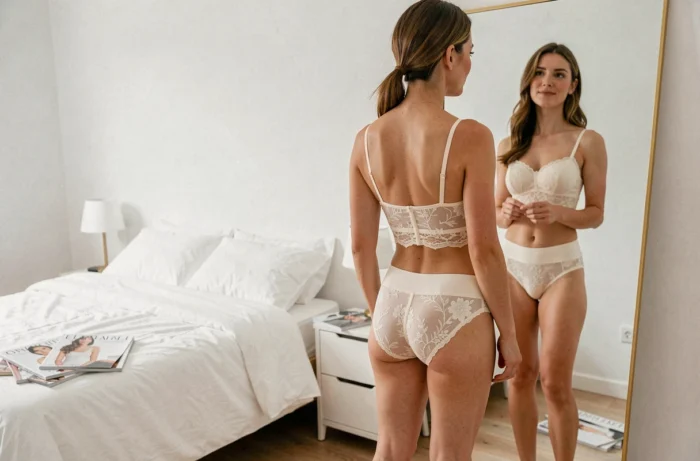
A strap that slips every ten minutes, a bra whose underwire leaves marks on the skin by midday, a pair of panties whose elastic rolls under high-waisted pants: we all know these micro-irritations that ultimately ruin comfort. The choice of everyday lingerie is based on very concrete criteria, well beyond color or pattern. Finding underwear that enhances the silhouette without sacrificing comfort requires checking a few specific points before purchase.
Fit Check: The Five Points to Try on a Bra
We often talk about body shape when choosing lingerie, but the real starting point is simpler: a structured fitting with several checks. Knowing your bust size is not enough if the piece is poorly adjusted once worn.
Here are the checks to make in the fitting room or in front of a mirror:
- The back of the bra remains horizontal, without riding up the upper back. If it rides up, the band size is too large or the straps are pulling too much.
- The underwires follow the contour of the breast without pressing on the breast tissue or gaping at the sides. An underwire resting on the breast compresses, while an underwire that pulls away no longer provides support.
- The cup is filled evenly, without empty fabric at the top or side overflow. Raising the arms allows you to check that the cup does not lift away.
- The straps stay in place without digging into the shoulder. You should be able to slide a finger underneath without forcing.
- The center gore (the central bridge) lies flat against the sternum. If it floats, the cup size is likely too small.
This check takes less than two minutes and avoids most sizing errors. To explore different cuts and materials that meet these criteria, a useful resource is: https://www.lingerie-seduction.com/, which offers a varied catalog of women’s models.
Sister Size in Lingerie: Managing Size Differences Between Brands
A 90B in one brand may correspond to an 85C in another. Size discrepancies between manufacturers are common, and the concept of sister sizing allows for adaptation without starting from scratch.
The principle is straightforward: if your usual size is tight at the back but the cup fits, you go up a band size and down a cup size. An 85C becomes a 90B. The reverse also works: a band that is too loose with a fitted cup gives an 80D instead of an 85C.
Returns vary on this point between brands, as some have larger band sizes and smaller cups. Keeping your sister size in mind prevents you from giving up on a model you like just because “the size doesn’t exist.” Before ordering online, checking the size guide specific to each brand remains the most reliable precaution.
Materials and Sensory Comfort: What Changes Over a Full Day
Body shape dictates the cut, but the material determines comfort over time. Wearing a bra or panties for eight hours straight involves parameters that a quick fitting may not reveal: seam friction, temperature rise, moisture absorption.
Cotton, Modal, Synthetic Fibers: Choose According to Use
Cotton remains the reference for softness and skin tolerance. Its downside: it absorbs moisture but dries slowly, which can create a clammy feeling in summer or during physical exertion.
Modal and Tencel Lyocell offer superior breathability with a silky feel. These fibers regulate temperature better and dry faster than pure cotton. A cotton-modal blend combines softness and moisture management, an effective compromise for everyday wear.
Synthetic materials (polyamide, elastane) provide support and flexibility, especially in underwired bras or shaping panties. They are useful in certain cases but should be used in moderation: worn in high proportions against the skin, they can generate heat.
Lace and Seams: The Detail That Changes Everything
Lace adds an obvious feminine touch, but not all lace is equal in comfort. Laser-cut lace with flat edges does not scratch. Thick lace with raw finishes can irritate the inner thighs or the underbust within hours. Checking the finishes by touch before purchase saves time.
Adapting Your Lingerie to Your Outfit of the Day
We often think of lingerie as a choice independent of the wardrobe, while the harmony between underwear and clothing prevents visible faux pas. A few common situations deserve to be anticipated.
Under a white top or thin fabric, a nude bra (matched to your skin tone, not necessarily beige) disappears better than a white model, contrary to what one might think. White under white creates a visible demarcation.
A backless top or plunging neckline calls for an adhesive bra, a bandeau, or a racerback style. Forcing a classic bra under an open-back dress results in an awkward look, regardless of the quality of the piece.
For high-waisted pants or skirts, a high-waisted panty or shorty avoids the elastic mark at the belly. A Brazilian panty is better suited under fluid and low-rise garments, where its cut remains invisible.
Renewing Your Lingerie: Concrete Signs of Wear
A bra loses its support long before it appears visually damaged. The elasticity of the band is the first reliable indicator: if you close the bra on the last hook (the tightest) and it still does not provide proper support, the band is stretched.
Straps that slip despite being adjusted to the maximum, underwires that poke through the fabric, a cup that wrinkles: each of these signs indicates that the piece no longer fulfills its function. Continuing to wear a worn-out bra alters breast support and can exacerbate back discomfort over time.
It’s better to have a few quality pieces in rotation than a dozen models worn until exhaustion. Alternating between three bras daily allows them to regain their shape between wears, significantly extending their lifespan.