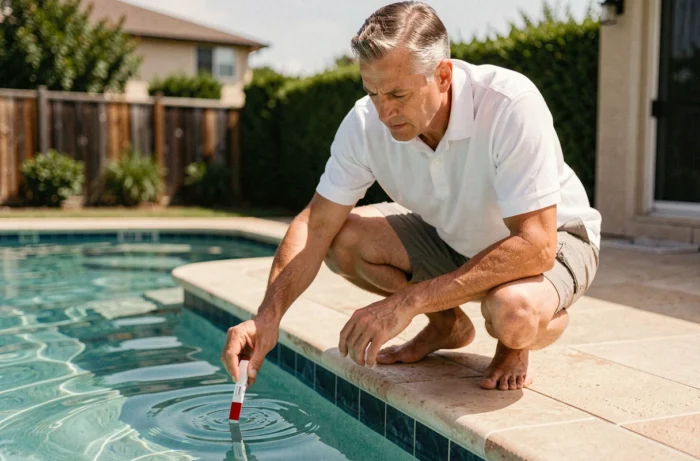
The salt level displayed by an electrolyzer does not always reflect the reality of the pool. The integrated sensors drift over time, the water temperature skews the readings, and adding salt based on an erroneous measurement can damage the equipment just as much as under-dosing. Before pouring any bags, the question is not “how much salt to add” but “is my measurement reliable.”
Reliability of salt sensors: what the integrated probe doesn’t tell you
Most electrolyzers display a salinity level on their control screen. This value comes from a conductivity probe that measures the conductivity of the water and then converts it into an estimated salt concentration. The problem: cold water reduces conductivity, causing the probe to underestimate the actual level.
At the beginning of the season, when the water is still below 18 °C, the gap between the displayed value and the actual concentration can be significant. Several recent guides recommend never relying on a single measurement source.
Before adding any salt, confirm the reading with a second tool: saline test strips or a portable electronic tester. These devices, available for a few dozen euros, measure salinity independently of the electrolyzer’s probe. If both values converge, the diagnosis is reliable. If they diverge by more than 0.5 g/L, it is the integrated probe that needs to be cleaned or recalibrated, not the salt level that needs to be corrected.
To fully understand the complete process before intervening in your pool, you can add pool salt with Murmures Déco which details the verification steps.
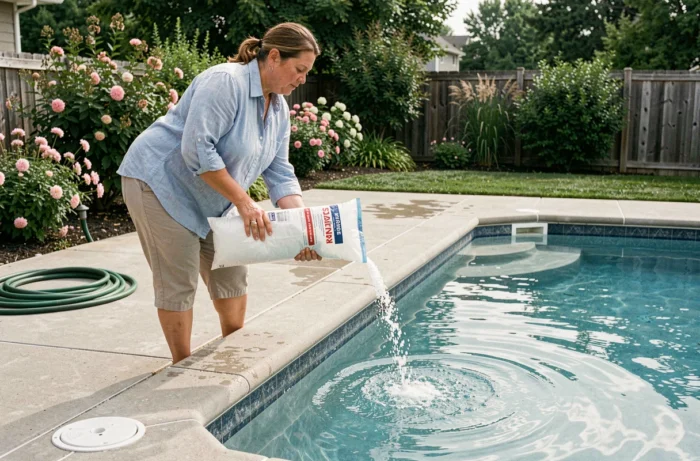
Salt levels by type of electrolyzer: compared operating ranges
Not all electrolyzers require the same salinity. Thinking “by pool” without consulting the device’s manual can lead to sometimes costly dosing errors. The table below summarizes the common ranges according to families of electrolyzers.
| Type of electrolyzer | Recommended salinity range | Consequence of a deviation |
|---|---|---|
| Standard models (majority of the market) | 3 to 5 g/L | Low alarm below 2.5 g/L, accelerated corrosion above 6 g/L |
| Low salinity models | 2.7 to 3.4 g/L (approximately 2,700 to 3,400 ppm) | Underproduction of chlorine below 2.5 g/L, premature wear of cells above 4 g/L |
| High-end connected systems | Variable depending on firmware, often around 3.2 g/L (3,200 ppm) | Automatic adjustment of production, but probe to be checked manually |
The electrolyzer’s manual takes precedence over any general rule. A low salinity device supplied with 5 g/L of saltwater will see its cells wear out prematurely. Conversely, a standard model set to 2.5 g/L will not produce enough chlorine to properly disinfect the pool.
Order of water corrections before adding salt
Recent guides emphasize a point that pages focused solely on dosing neglect: salt is never corrected first. The balance of the water depends on several interdependent parameters, and adjusting salinity before stabilizing pH or TAC (total alkalinity) skews the entire process.
Here is the recommended order of correction when restarting or after a significant water addition:
- Check and adjust pH between 7.0 and 7.4. A pH that is too high decreases the effectiveness of the chlorine produced by the electrolyzer, regardless of the salt level.
- Check TAC (alkalinity). Unstable alkalinity causes pH fluctuations that make any salt dosing unnecessary in the short term.
- Measure salinity with two distinct tools (integrated probe and independent tester), then calculate the amount of salt to add based on the actual volume of the pool and the target range of the electrolyzer.
- Add the salt only after stabilizing the other parameters, with the pump running, distributing it throughout the pool rather than in a single spot.
Correcting salt in water with an unbalanced pH is like adjusting the volume of a radio with a poorly oriented antenna. The signal remains poor.
Filtration after adding salt: why wait before judging
Pool salt, even fine-grained, does not dissolve instantly in a large volume of water. After pouring, maintaining continuous filtration for 24 to 48 hours allows for homogeneous dissolution and uniform distribution throughout the pool.
Turning off the pump too early creates areas of uneven concentration. The bottom of the pool, where undissolved salt tends to accumulate, may have very high salinity while the surface remains below threshold. The electrolyzer, which draws water from a fixed point, then measures a level that does not represent the average of the pool.
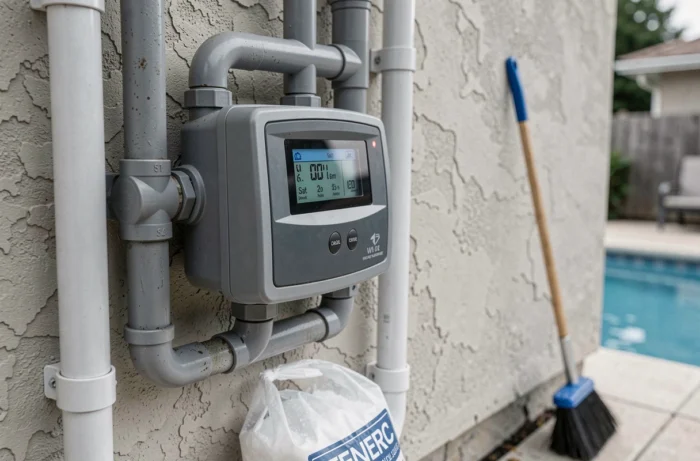
However, after these 24 to 48 hours of mixing, a new measurement with the independent tester provides a reliable picture. It is only at this point that any additional salt can be considered. Adding salt in two stages (an initial dose followed by an adjustment after checking) reduces the risk of overdosing, which is more difficult to correct than under-dosing.
Salt overdose: the most costly correction
Removing salt from a pool is impossible without partial draining. A fraction of the salty water must be replaced with fresh water, which incurs a cost in water and a chemical imbalance that must be fully corrected again. Even a slight overdose accelerates the corrosion of metal parts, reconstituted stone coping, and liners.
Under-dosing, on the other hand, is easily corrected by adding salt. This asymmetry argues for a cautious approach: it is better to add slightly less than the calculated dose, filter, measure, and then complete if necessary.
The salinity of a pool only decreases through dilution (rain, water addition, splashes, backwashing the filter). In the absence of these events, the salt remains in the water. Checking the level once a month during the season and after each heavy rain episode is sufficient to maintain balance without excessive intervention.