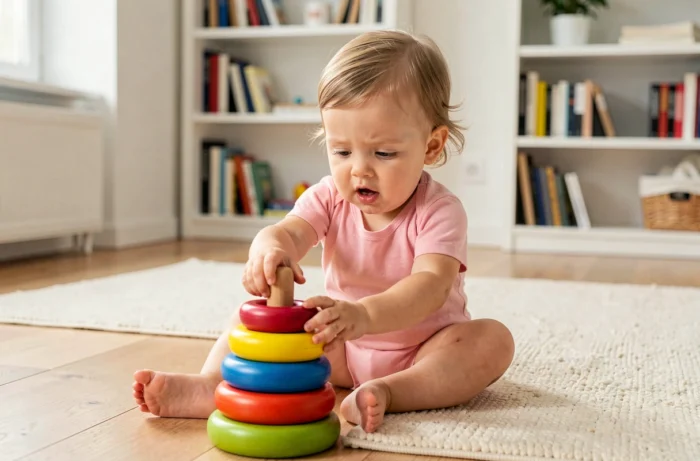
A 1-year-old child methodically emptying a toy basket to keep only one is a scene that all parents know. This instinctive sorting reflects a specific need: at this age, the brain selects stimuli that correspond to its stage of development. Choosing the right developmental toys for a little girl of 1 year means understanding this natural filter and offering objects that meet it, without overloading the play space.
Toy recalls and safety: what the CE marking does not cover
It is often thought that the CE marking is enough to guarantee that a toy is safe. In practice, this marking certifies compliance with a European directive at the time of market release, but it does not protect against all risks in real situations. A wooden rattle was recently recalled by Rappel Conso, specifically due to a choking hazard related to its dimensions, even though it bore the CE marking.
This case illustrates a concrete point: wooden or seemingly simple toys are not free from dangers. Before buying a developmental toy, one can search for its exact reference in the recall notices published on the government website. This reflex is also valuable after purchase, as a recall can occur several months after commercialization.
To complement this vigilance, one should check that no part of the toy can detach and be swallowed. Standards set a minimum size threshold for small parts, but rapid wear (chipped paint, loose stitching) can create a danger that did not exist when the box was opened. Regularly inspecting used toys remains the best defense.
The European regulatory framework is evolving with regulation 2025/2509, which provides for a digital product passport. Its general application is scheduled to begin on August 1, 2030. Until then, the current directive remains the applicable framework, and manual verification by parents remains the most reliable supplement.
By browsing the toys for 1-year-old girls on Esprit Maman, one can find selections that take into account these safety criteria suitable for this age.
Fine motor skills at 1 year: which developmental toys engage the thumb-index pinch
By around 12 months, the thumb-index pinch is established in most children. This is the moment when a little girl transitions from the sweeping motion (grabbing with a full hand) to the ability to grasp an object between two fingers. This motor change radically alters the type of toy that interests her.
Wooden shape sorters and stacking toys
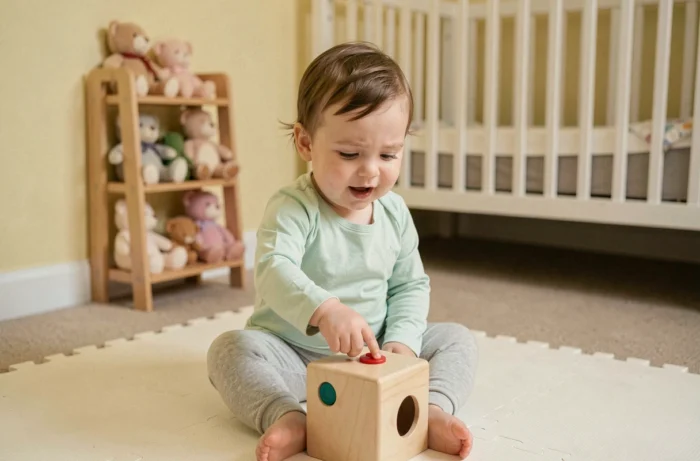
Shape sorting games with simple geometric shapes (circle, square, triangle) engage this pinch and train hand-eye coordination. One should favor pieces that are large enough to be manipulated without frustration, but not too heavy. A shape sorter made of raw or water-painted wood withstands shocks and repeated mouthing better than a thin plastic equivalent.
Stacking towers operate on the same principle. The child learns to adjust the size of the rings, correcting a missed move. This type of toy does not need sounds or lights to capture attention: it is the physical resistance of the object that generates learning.
Complex rattles and activity cubes
At 1 year, simple rattles begin to lose their appeal. One moves on to rattles with multiple textures or activity cubes that combine rotation, pulling, and pressing. These toys require varied gestures within the same object, which maintains interest for a longer time.
A well-designed activity cube replaces several toys on its own. One should check that the movable elements (wires, beads, flaps) are securely attached and do not pose a risk of detachment.
Sensorial toys for 1-year-old babies: beyond bright colors
Sensorial stimulation is not limited to the visual. At 12 months, touch and hearing are the most active channels in exploration. A toy that offers several materials (smooth fabric, velvet, wood, rubber) within the same object allows the child to compare tactile sensations without changing toys.
- Montessori-style sensory balls, with their fabric pads, allow for easy handling and controlled throwing, which also encourages gross motor skills
- Fabric or thick cardboard books with lift-the-flap features combine tactile exploration and the beginning of storytelling, a support that works particularly well at bedtime
- Simple instruments (wooden maracas, lightweight tambourines) provide immediate sound feedback that helps the child understand the link between their action and the effect produced
The temptation to accumulate sensory toys is real. Better results are obtained by offering three or four objects at a time and rotating them weekly. The child thus rediscovers a set-aside toy with fresh eyes and motor skills that have progressed in the meantime.

Developmental toys and walking: adapting the selection to first steps
Around 12 months, some little girls are already walking, while others are still at the stage of rapid crawling. The choice of developmental toys directly depends on the child’s motor stage, not their chronological age. A child who moves upright benefits from weighted push carts, which provide stable support and enough resistance to rolling to prevent falls forward.
For a child still on the ground, pull or push toys while crawling remain more suitable. A wheeled animal with a short string encourages movement and works on limb coordination. The transition from the ground to standing also transforms how the child uses their hands: once they no longer need their arms for balance, they can manipulate objects while walking, opening up a new realm of play.
A rarely discussed point concerns the weight of the toy. A push cart that is too light tips over, while one that is too heavy discourages. The right compromise is found by testing stability oneself: if the cart rolls back when pressing down on the handle at child height, it is too light to serve as a reliable support.
Choosing developmental toys for a little girl of 1 year ultimately comes down to observing what she is already doing with her hands and legs, and then offering her the next step. Neither too simple (she gets bored) nor too complex (she gives up). The toy that works is the one she picks up again after putting it down.