
Installing an outdoor air conditioning unit on a party wall is not governed by the same rules as a simple board or shelf. Article 662 of the Civil Code prohibits leaning or supporting a structure on a party wall without the consent of the co-owner of the wall. An air conditioner, due to its vibrations, weight, and noise emissions, fully falls into this category of structures requiring prior agreement.
Sound emergence and regulatory threshold near a party wall
The point that most installation guides overlook is the measurable acoustic constraint. In France, the permissible sound emergence is limited to 5 dB(A) above the existing ambient noise during the day, measured at the boundary of the neighboring property. This threshold applies to all fixed installations, including air conditioners.
On a party wall, the distance between the outdoor unit and the neighboring property is by definition zero or nearly zero. Even a device advertised as silent by the manufacturer can exceed this emergence threshold when mounted directly on the common wall, as the wall structure transmits low-frequency vibrations.
We always recommend using anti-vibration supports (silent blocks) between the unit and the wall, or even a cantilever installation on the ground if the refrigerant line allows for it. An acoustic survey before and after installation, conducted by an acoustician or with a class 2 sound level meter, provides the best protection in case of subsequent disputes.
The details of the rules for installing air conditioning on a party wall confirm that this sound constraint is often the primary reason for disputes between neighbors.
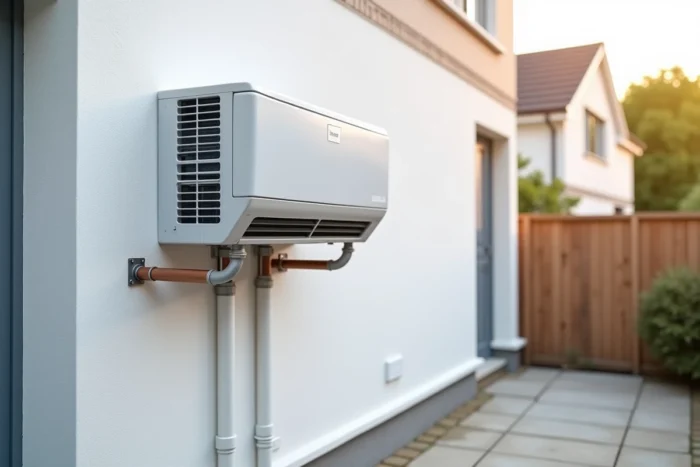
Article 662 of the Civil Code: neighbor’s consent for an air conditioner
Article 662 establishes a clear principle: no co-owner of a party wall can lean a structure against it without the agreement of the other. The neighbor’s consent must be obtained before any installation, not after. An oral agreement is not sufficient in case of a dispute: we find that local judges require a written document, ideally a registered letter or a private deed specifying the nature of the device, its location, and maintenance conditions.
The neighbor’s refusal blocks the project on the party wall. It does not block the installation itself. The alternative is to place the unit on your own private wall, on a slab on the garden side, or on a rooftop support if the local PLU allows it.
Difference between party wall and private wall at the property boundary
A wall built entirely on your plot, even if it runs along the boundary, is private. You can install an air conditioner on it without the neighbor’s consent, provided you comply with urban planning regulations and the sound emergence threshold. Confusion between the two statuses is common. The property title and cadastral boundary determination can clarify this.
Prior declaration at the town hall and co-ownership rules
Installing an outdoor air conditioning unit on the facade or at the property boundary may require a prior declaration of works at the town hall. This is not systematic, but several cases mandate it:
- The local urban planning plan (PLU) of the municipality prohibits or regulates visible technical equipment on the facade, especially in heritage areas or in ABF sectors (Architect of Buildings of France).
- The installation alters the external appearance of the building, triggering the obligation to declare under the Urban Planning Code.
- In co-ownership, the co-ownership regulations generally require authorization from the general assembly before any installation affecting common areas or the appearance of the building.
In co-ownership, an air conditioner installed without a vote in the general assembly can be removed at your expense, even several years after installation. This risk is real and documented. Check the co-ownership regulations before signing a quote.

Pre-charged air conditioning and party wall: installation without a refrigeration technician does not exempt from anything
Pre-charged split systems (known as quick connect) allow an individual to perform wall mounting, drilling, and electrical connections without the intervention of a certified professional, as long as the refrigerant circuit remains sealed. The handling of refrigerant (vacuuming, charging, opening the circuit) is reserved for certified professionals in accordance with the European F-Gas Regulation No. 517/2014 and the Environmental Code.
This technical ease does not change the legal obligations. Whether you install the device yourself or through an installer, the written consent of the neighbor (art. 662), the declaration at the town hall if necessary, and compliance with the sound emergence threshold apply equally.
Checks before drilling a party wall
Before any intervention on the structure, several checks are necessary:
- Confirm the party or private status of the wall through boundary determination and property title.
- Identify the nature of the wall (concrete block, stone, brick) to adapt the fixings and anticipate vibrational transmission.
- Check for the absence of networks (electricity, water, gas) within the thickness of the wall, especially for older adjoining houses.
- Plan for a refrigerant line and condensate drainage that does not create infiltration into the common wall.
A poorly executed drilling on a party wall makes you liable for damages caused to the common structure. Home insurance does not always cover work done without the agreement of the co-owner of the wall.
The legal framework for air conditioning on a party wall is based on three pillars: the neighbor’s consent under Article 662, compliance with the sound emergence threshold at the property boundary, and adherence to local urban planning regulations. Neglecting any of these three points exposes you to forced removal or a ruling for abnormal neighborhood disturbance.