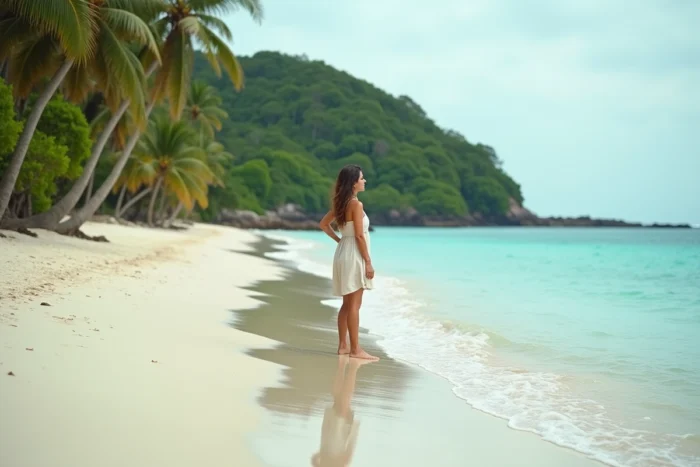
In Guadeloupe, the sun rises around 5:45 AM and sets around 6:30 PM, regardless of the time of year. This tropical regularity offers a stable but shorter beach window than one might imagine. Choosing the right time slot radically changes the experience: thermal comfort, light quality, sea conditions, and crowd levels vary from hour to hour on the same sand.
Tropical Light and Beach Time Slots in Guadeloupe: What Latitude Changes
Under the tropics, the sun’s path differs from what we know in mainland France. The intensity rises quickly after sunrise, and the zenith is very high in the sky. As a result: between 11 AM and 3 PM, UV radiation peaks, much more aggressive than in mainland France at the same hour.
The light is usable from 6:30 AM. It remains soft and low, ideal for swimming and photos until around 10 AM. After 4 PM, the sun descends, and the beach becomes pleasant again, but brightness decreases quickly after 5:30 PM.
Have you noticed that locals swim very early in the morning? It’s not by chance. Arriving at a beach like Anse de la Caravelle or Malendure before 8 AM allows you to enjoy calm water, cool sand, and almost no visitors. To delve deeper into the question of beach timing in Guadeloupe on Conceze, this early slot consistently comes up as the most recommended by locals.

Morning or Late Afternoon: Which Time Slot to Choose Based on Your Beach Activity
The best time depends on what you plan to do. Not all activities benefit equally from the same time slot.
Swimming and Snorkeling Early in the Morning
The 6:30 AM to 10 AM slot offers the best underwater visibility. The sea is often calmer in the early part of the day, before the thermal wind picks up. At snorkeling spots like Malendure, the wildlife is also more active at this hour.
Thermal comfort is another advantage. The air is cool (without being cold), the sand doesn’t burn your feet, and getting out of the water doesn’t cause a heat shock.
Relaxing and Swimming in the Late Afternoon
After 4 PM, the air temperature starts to drop, but the water remains warm all year round in Guadeloupe. This is the preferred time for families with children who want to avoid sunscreen every hour.
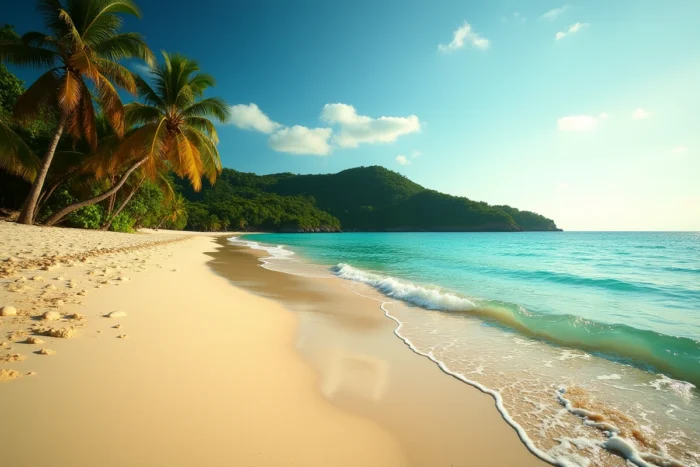
The golden light of late afternoon gives the white sand beaches (Sainte-Anne, Saint-Louis) a special hue. However, brightness drops quickly after 5:30 PM, leaving a useful slot of about an hour and a half.
What to Avoid
- The 11 AM to 3 PM window exposes you to maximum UV radiation, even under a slightly overcast sky. Sunburn can occur in just a few minutes without proper protection.
- Popular beaches like Caravelle or Anse du Souffleur reach their peak attendance between 10 AM and 2 PM, especially during the dry season (December to April).
- The thermal wind usually picks up in mid-morning and can make snorkeling less comfortable on the west coast.
Dry Season or Rainy Season: Does the Ideal Timing Change?
Guadeloupe alternates between the dry season (from December to April) and the rainy season (from June to November). The sunrise and sunset times change very little from one season to another, which simplifies planning.
What changes is the weather behavior throughout the day. During the rainy season, showers often occur in the early afternoon, sometimes intensely but briefly. Mornings generally remain dry and sunny, further enhancing the appeal of the morning slot.
In the dry season, the entire day is often clear. The late afternoon slot is therefore more reliable than during the wet season, when clouds can settle as early as 3 PM in certain areas, particularly in Basse-Terre.
Adapting Your Beach Choice to the Season
The beaches of Grande-Terre (Sainte-Anne, Saint-François) benefit from a drier climate than those of Basse-Terre. During the rainy season, favoring Grande-Terre in the morning allows you to combine two advantages: less rain and fewer people.
The beaches of Basse-Terre, like Malendure, are more exposed to afternoon rainfall during the wet season. For snorkeling at this spot, aiming for 7 AM to 9 AM during the rainy season remains the safest strategy.
Sargassum and Crowds: Two Factors That Alter the Optimal Timing
Sargassum wash-ups affect certain beaches in Guadeloupe, mainly on the Atlantic coast. These algae emit an unpleasant odor when decomposing in the sun. In the morning, before the heat accelerates fermentation, the smell is significantly less noticeable.
Why does this detail matter? Because a beach marked “affected by sargassum” can be quite pleasant at 7 AM and become uncomfortable by noon. Checking Météo-France Guadeloupe bulletins on sargassum before choosing your beach for the day allows you to adjust your plans.
Regarding crowds, beaches near tourist areas (the Gosier triangle, Sainte-Anne, Saint-François) fill up starting at 10 AM during high season. On more isolated beaches like Anse de Gros Sable or certain coves of Terre-de-Haut in Les Saintes, attendance remains low regardless of the hour.
- Tourist beaches (Caravelle, Datcha): arrive before 9 AM or after 4 PM to avoid the crowd.
- Basse-Terre beaches (Malendure, Grande Anse): 7 AM to 10 AM is optimal for swimming and snorkeling.
- Beaches in Les Saintes or Marie-Galante: crowds are rarely an issue, but the morning slot remains preferable for solar comfort.
Ultimately, a beach day in Guadeloupe revolves around two short windows. The 6:30 AM to 10 AM slot concentrates the best conditions: calm sea, soft light, quiet beach, and manageable sargassum. The 4 PM to 5:30 PM slot offers a pleasant complement, especially in the dry season. Between the two, it’s better to explore the inland, visit a distillery, or take refuge in the shade of a restaurant with your feet in the sand.