Parental support influences a child’s educational trajectory and psychological health far beyond just homework help. But which aspects of this support produce measurable effects, and which are more about conventional discourse? Identifying the concrete mechanisms allows us to distinguish what truly changes the game for children’s success and well-being.
Parental Support and Post-COVID Mental Health: A Documented Protective Factor
The health crisis has changed the landscape. Santé publique France has emphasized since 2023 that the quality of family emotional support protects against school stress and anxiety disorders that emerged or worsened in children after the pandemic. The return to school, the catch-up on learning, and psychological fatigue have created a conducive environment for school anxiety.
This observation changes the very nature of the expected parental support. Before 2020, support focused strictly on academics: homework help, monitoring results, contact with the school. Since then, the emotional dimension has taken center stage. A parent who recognizes signs of anxiety related to the fear of failure and responds with reassuring presence directly impacts the child’s ability to engage in learning.
As detailed in the advice from the Club des Parents, this support is not limited to occasional reassurance: it is part of a daily posture that builds a lasting sense of security.

Four Fundamental Skills Developed in the Family Before School
The AlphaOmega Foundation identifies four competencies whose mastery conditions later academic success: literacy, numeracy, psychosocial skills, and motor skills. These four skills develop within the family even before entering preschool.
The table below summarizes how each skill is built at home and what happens in the case of insufficient support.
| Skill | Concrete Parental Lever | Consequence of a Support Deficit |
|---|---|---|
| Literacy | Shared reading, daily discussions, vocabulary enrichment | Marked vocabulary gap by age 3 depending on social background |
| Numeracy | Counting games, manipulation of objects, time markers | Difficulty entering mathematical reasoning in first grade |
| Psychosocial Skills | Emotion management, cooperation, conflict resolution | Behavioral issues, isolation in group settings |
| Motor Skills | Physical activities, outdoor games, fine manipulation | Graphomotor delays, writing difficulties |
What stands out in this data is that the gaps between children widen before the first day of class. Social background amplifies these differences: families with more resources typically provide a richer environment for language interactions and diverse activities.
Parental Academic Support: The Line Between Support and Pressure
A paradox runs through the issue of parental support in education. Parental involvement in homework and academic monitoring is associated with better outcomes. However, when this involvement turns into pressure for performance, the effects reverse.
Academic Perseverance and Child Autonomy
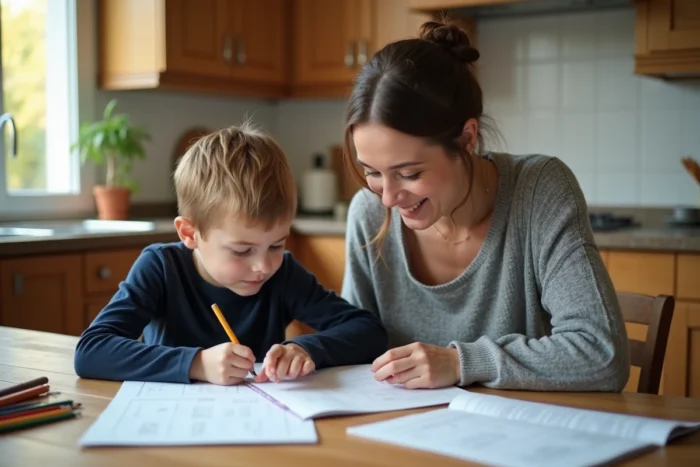
Encouraging academic perseverance starts at home, but not by doing the homework for the child. An effective support develops autonomy rather than dependence. This involves specific behaviors:
- Encouraging effort rather than results: valuing the work done, not just the grade received, strengthens the child’s intrinsic motivation
- Creating a regular work environment without constant supervision: a quiet place, a stable schedule, and the opportunity to ask for help when the child feels the need
- Accepting mistakes as a learning step: a child who fears failure eventually avoids new learning situations
The fear of failure in a child often mirrors parental anxiety about academic results. A parent who verbalizes their confidence in their child’s abilities, even after a poor result, influences long-term perseverance.
Parent-School Relationship: An Underutilized Lever
The link between family and school is not limited to parent-teacher meetings. Regular exchanges with the educational team allow for adjusting support to meet real needs. A child struggling in mathematics does not need the same support as a child who is disengaged due to lack of motivation.
Co-parenting, even in separation situations, plays a direct role. When both parents maintain coherent communication around education, the child benefits from a stable environment. Conversely, a conflicting co-parenting situation undermines the child’s mental health and, in turn, their availability for learning.

Positive Parenting and Daily Life: What Matters Beyond School
Narrowing parental support to academic success would be a mistake. A child’s well-being also relies on the quality of family interactions outside the school framework. Moments of reading, play, and open conversation build an emotional foundation that school alone cannot provide.
Research shared by Psycom reminds us that parents’ mental health directly influences that of their children. A parent who is exhausted or suffering psychologically has fewer resources to provide quality support. Therefore, parenting support, through collective or individual initiatives, benefits both adults and children.
- Verbalizing one’s own emotions in front of the child teaches them to identify and express their own
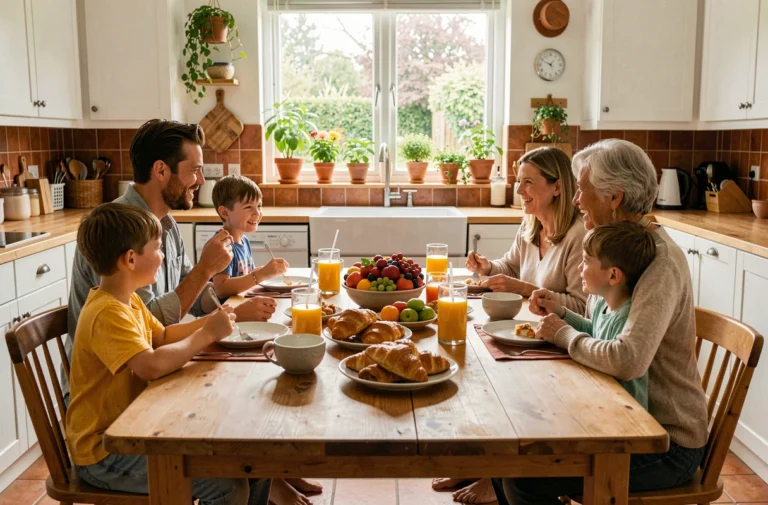
- Maintaining family rituals (shared meals, playtime) anchors a sense of emotional security
- Seeking external help (parenting guidance, support groups) is not an admission of failure but a preventive act
Parental support that produces lasting effects on children’s success and well-being is not the kind that focuses solely on report cards. It is the one that combines emotional presence, a structured environment, and the ability to ask for help when needed. The four fundamental skills are built early, gaps widen quickly, and the most decisive window for action is before and during the early years of schooling.