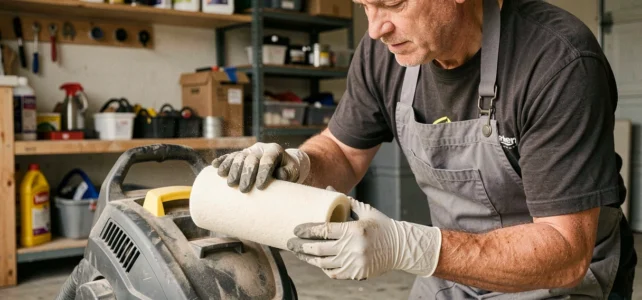
The Kärcher WD4 remains one of the most popular wet and dry vacuums among homeowners and on light construction sites. Its flat pleated filter, the central piece of the filtration system, directly affects suction power and motor longevity. Gradual clogging is not always visible to the naked eye, but its effects are quickly measurable: loss of airflow, overheating, and the release of fine particles into the ambient air.
Kärcher WD4 flat pleated filter: what wear does to the motor
The flat pleated filter serves a dual purpose: trapping the particles being vacuumed and protecting the motor from fine debris that could reach the turbine. When the pleats become laden with compacted dust, the airflow decreases, and the motor compensates by running faster, which accelerates its mechanical wear.
This overload does not trigger any indicator lights on the WD4. The only noticeable sign is a gradual decrease in suction power at the flat nozzle or floor attachment. Many users attribute this symptom to a problem with the bag or hose, while the filter is actually to blame.
A often overlooked point: alternating suction of water and dust without intermediate cleaning creates a damp mixture that solidifies between the pleats. Kärcher also offers a WD/SE cartridge filter that allows for dry and liquid suction without changing the filter between uses, thus reducing the handling that accelerates degradation. The procedure for cleaning the Kärcher WD4 filter is worth mastering before considering a replacement.
Cleaning the Kärcher WD4 filter: dry method vs. water washing
Two approaches coexist, and field feedback varies on their respective effectiveness depending on the type of use.
Dry cleaning by tapping and blowing
The quickest method involves removing the filter, tapping it firmly against a hard surface (never a sharp edge that could tear the filter media), and blowing between the pleats with low-pressure compressed air. This technique is suitable after vacuuming dry construction dust or sawdust.
Its limitations become apparent quickly: the finest particles remain embedded in the fibers of the pleated filter. After several cycles of dry cleaning, the filter surface loses permeability even if it appears visually clean.
Washing with lukewarm water without harsh detergent
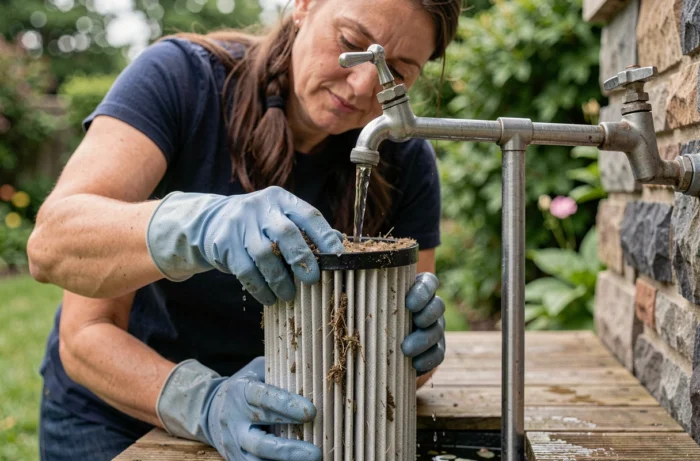
A rinse under lukewarm water, directing the jet from the inside out of the filter, dislodges the compacted particles between the pleats. The critical point is drying: a filter reinstalled while still damp promotes mold growth and can damage the motor by spraying droplets.
Complete drying takes a significant amount of time, sometimes more than a day in a poorly ventilated environment. Speeding up the process with a hairdryer risks distorting the filter media due to heat.
- Tap the filter at each tank emptying, even after short use, to prevent the gradual compaction of dust
- Reserve water washing for situations where dry cleaning no longer restores suction power
- Allow the filter to dry flat in a ventilated area, away from direct light, and never reinstall it before it is completely dry
- Have a spare filter on hand to avoid immobilizing the device during drying
When to replace the flat pleated filter rather than clean it
Cleaning, no matter how methodical, has a mechanical limit. Each cycle of washing and handling weakens the pleats of the filter media. Invisible micro-tears allow fine particles to pass through directly to the motor compartment.
Kärcher sells a replacement flat filter dedicated to the WD 4, WD 5, and WD 6 series. This component remains available in the official catalog, confirming that the brand does not consider the original filter as a part with an unlimited lifespan.
Several signals indicate that replacement becomes preferable to cleaning:
- The suction power does not return to the initial level after a complete wash and prolonged drying
- The filter shows discolored or stiffened areas, signs of irreversible deep clogging
- Persistent odors emanate from the filter despite washing, indicating bacterial growth in the fibers
Compatible and reusable filters: a trend to evaluate with caution
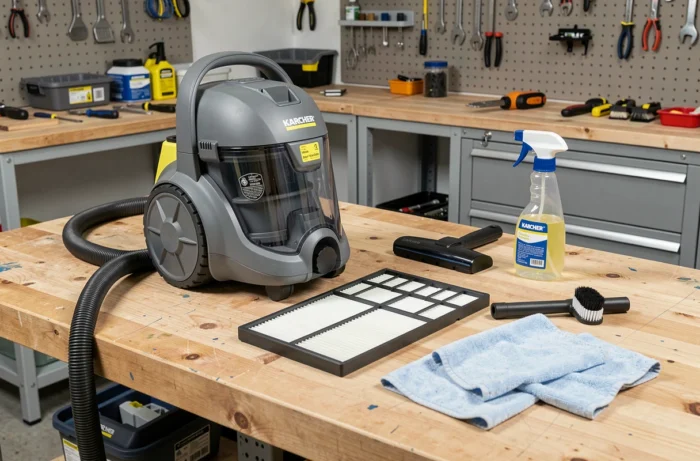
Marketplaces are increasingly offering replacement filters for WD4, WD5, and WD6 sold as “washable” and “reusable,” often at significantly lower prices than original parts. This growing offer reflects a field demand for simplified maintenance.
However, the quality of the filter media varies significantly from one third-party manufacturer to another. A cheap filter that allows more fine particles to pass through offers less protection for the motor, which can ultimately cost more than an original filter replaced at the right time.
The most reliable selection criterion remains the density of the filter media and the precision of the fit on the tank support. A poorly fitted filter creates an unfiltered air passage that nullifies all the benefits of filtration, regardless of the material quality. Checking the seal between the filter and the tank after each reinstallation should be part of the maintenance routine just like cleaning itself.
A final point rarely addressed: alternating between two filters (one in use, one drying) reduces the frequency of replacement and ensures that the device remains operational at all times. This rotational operation is particularly suitable for users who alternate between dry suction and water suction on construction sites or in workshops.