
When you enter a Zara on a Saturday afternoon, the racks change almost at a glance. A dress spotted the previous week has disappeared, replaced by a cut that recalls a Milanese fashion show from three weeks ago. This constant renewal is not a logistical coincidence; it is the heart of the model that separates Zara from its direct competitors.
Zara’s Production Cycle: Speed as a Structural Advantage
Most fast fashion brands plan their collections several months in advance. Zara operates differently: the time between sketch and shelf is measured in weeks. The Inditex group has built its chain around logistics centers located in Spain and nearby production countries (Portugal, Morocco, Turkey), which shortens transportation and allows for real-time market response.
Specifically, store managers report daily sales data and customer feedback. If a model isn’t performing, production stops. If a trend explodes on social media, a prototype can be launched immediately. This is far from the classic model where unsold items end up marked down by fifty percent.
This system has a direct effect on positioning strategy: Zara produces in limited quantities per reference. Customers know that an item may no longer exist the following week, creating an immediate buying reflex. To delve deeper into this mechanism, one can refer to the Zara case study on Fimina Mag which details the brand’s differentiation levers against its rivals.
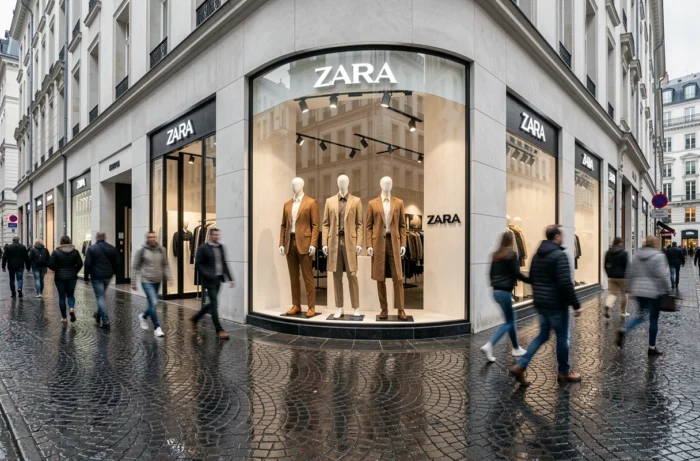
Price Positioning and Segmentation: Zara Between Luxury and Fast Fashion
Zara does not play the same game as H&M or Primark when it comes to the lowest prices. The brand aims for what is called “masstige”: an accessible price backed by visual codes borrowed from luxury. The collaboration with designer Stefano Pilati illustrates this ambition. The cuts, materials, and in-store merchandising evoke more of a fashion house than a mass textile distributor.
This segmentation creates a halo effect around the brand. Customers are willing to pay a little more than elsewhere because the in-store experience, product staging, and constant renewal maintain a perception of rarity.
The Gap Between Image and After-Sales Service
However, there is a point of friction. Zara’s premium image does not always translate into customer service. With a Trustpilot rating around 1.3 out of 5, feedback on logistics and after-sales service remains very critical. The gap between aesthetic excellence in-store and the post-purchase online experience poses a real risk for customer loyalty.
For a company that invests so much in its image, this dissonance can become a point of attack for competitors more attentive to the overall experience, like Uniqlo, which focuses on sustainable quality and service.
Zara’s Distribution Strategy: The Physical Network as a Marketing Weapon
With over 2,000 stores spread across a hundred countries, Zara uses its points of sale as full-fledged communication tools. Unlike other brands that invest heavily in traditional advertising, Zara allocates very little budget to classic media communication. The store itself serves as an advertising showcase.
The location of the boutiques is strategic: premium shopping streets, busy city centers. The flagship store on the Champs-Élysées in Paris is not just a point of sale; it is a brand manifesto. This approach reduces dependence on paid campaigns and strengthens the direct link with the customer.
- Rapid rotation of collections in-store to encourage frequent visits
- Reduction of stock per reference to create a sense of urgency to buy
- Flagship locations in high-traffic areas, replacing traditional advertising investments
- Real-time data collection from the field to adjust production

Zara Facing New European Regulations on Sustainable Fashion
Zara’s model is now facing increasing regulatory pressure. The European regulation on the eco-design of sustainable products prohibits large EU companies from destroying their unsold clothing, shoes, and accessories. They must prioritize selling, donating, repairing, or refurbishing.
For a brand whose model relies on rapid stock turnover, this is a structural change. Zara has launched a resale, alteration, and repair platform in 17 markets. This shift towards circularity is not just a marketing response: it is an operational necessity to continue functioning within the European legal framework.
The Royal Decree 214/2025 in Spain
On the parent company side, Inditex faces an even more stringent framework. The Royal Decree 214/2025, which came into effect in June 2025 in Spain, imposes enhanced carbon reporting: annual footprint calculation, reduction plan, and data publication. For a group whose production chain spans multiple continents, carbon transparency becomes a compliance issue as much as an image concern.
Feedback varies on the actual capacity of these measures to fundamentally transform the fast fashion model. What is certain is that the regulatory environment is pushing Zara to integrate sustainability not just as a marketing argument, but as a daily management constraint.
Zara vs. Shein: The Battle for the Entry-Level Segment
The Inditex group is preparing to deploy Lefties, its brand positioned in the low-end segment, to directly respond to Shein and Temu. Zara itself is not lowering its prices: the brand protects its masstige positioning while Lefties absorbs competitive pressure from below.
This internal segmentation strategy within the group is a deliberate choice. Rather than diluting the Zara image by cutting prices, Inditex creates a buffer with a distinct brand. The risk would be that customers associate the two brands and perceive Zara as merely a premium version of a discount group.
- Zara maintains its accessible premium fashion positioning
- Lefties targets the ultra-competitive segment against Shein and Temu
- Uniqlo and Primark occupy different niches (sustainable basics and floor prices)
Zara’s strength remains its ability to coexist production speed, brand image, and a global physical network. Current challenges, from poor after-sales service to environmental constraints, do not undermine the model but compel the brand to strengthen entire areas of its organization.
The next test will be to prove that circularity and carbon transparency can coexist with one of the fastest renewal rhythms in the textile industry.