
During the practical driving test for the B license, the inspector asks three oral questions drawn from a bank of 100 combinations. Each correct answer earns a bonus point, for a total of three easily accessible points. These points are never eliminatory in case of an error, but they can tip a close result in your favor. However, you need to know how to prepare for them without spending hours cramming an endless list.
Three families of questions, not a hundred isolated questions
The official list, validated by the Delegation for Road Safety in a document dated January 21, 2023, is structured into three distinct families. Understanding this architecture changes the way you revise.
The first family concerns the checking of a vehicle element, either inside or outside. You are asked to show a device or perform a concrete action: adjust the height of the headlights, open the hood to locate the windshield washer reservoir, check the cleanliness of a mirror.
The second family relates to road safety. The question is linked to the checking action that precedes it. For example, after showing the headlight height adjustment, you are asked why this adjustment exists. The answer is one sentence long: to avoid dazzling other road users.
The third family is about first aid. These questions are often the most neglected, even though they follow a simple logic: protect, alert, rescue. Knowing how to describe the alert signal of the SAIP or explain how to secure a danger zone after an accident involves the same reflex.
Rather than memorizing a hundred answers one by one, group them by family. A candidate who masters the logic behind each category can find the answer even when faced with a formulation they have never read. Preparing the quiz of the 100 driving license questions with this family approach significantly reduces the volume to remember.
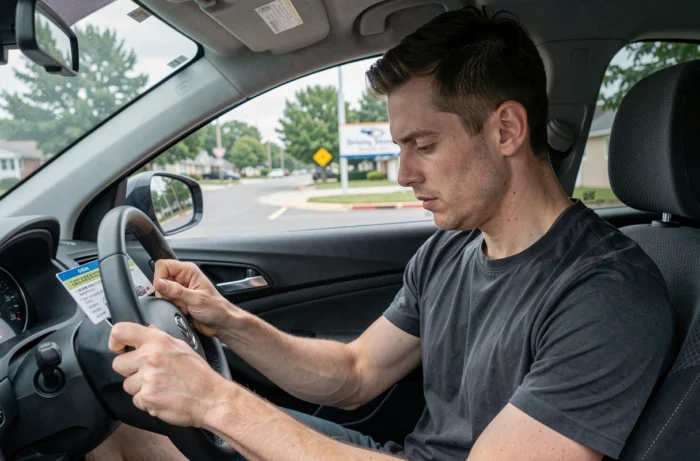
Memorizing vehicle checks: the method of action before words
You may have noticed that some answers seem obvious when sitting in the car, but impossible to articulate in front of a blank sheet? That’s normal. These questions are designed to be answered in context, not recited by heart.
The most effective method is to physically practice each check in the vehicle. Sit in the driver’s seat, locate the control, manipulate it, then articulate the answer out loud. The brain associates the action with the word, and retrieval from memory becomes almost automatic on the day of the exam.
Let’s take a concrete example. The question asks you to show where the rear defrost control is located. If you have searched for it just once on the dashboard, your fingers will remember. If you have only read the answer on a list, you might confuse it with the ventilation.
Group checks by area
Classify the interior checks according to their position: to the left of the steering wheel (light controls, height adjustment), to the right (wipers, washer), in the center (hazards, defrosting). For exterior checks, think in three zones: front of the vehicle (hood, levels), sides (tires, mirrors), rear (brake lights, license plate).
- Left zone of the steering wheel: light switches, height adjustment, turn signals. All these controls share the same manipulation logic.
- Hood zone: oil level, coolant, washer fluid. The answer always involves opening the hood and pointing to a reservoir or gauge.
- Side exterior zone: condition of tires, cleanliness of windows, adjustment of mirrors. The action consists of showing, touching, or indicating a visible element without tools.
This spatial breakdown transforms a list of questions into a mental map of the vehicle. Three interior zones, three exterior zones, six reference points in total.
First aid and road safety: answers that are built
First aid questions frighten many candidates. They concern situations that one has never experienced: accident, breakdown on the highway, SAIP alert. The good news is that almost all follow the triptych protect, alert, rescue.
When you are asked how to secure a danger zone after an accident, the answer logically builds itself. First, clearly and broadly delineate the area. Then make it visible to other road users. The goal: to prevent a secondary accident. You don’t need to know the exact wording; you need to understand the sequence.
Road safety: link each question to its checking action
Road safety questions do not come up randomly. They are always coupled with the preceding check. If the check concerns the tires, the safety question will relate to the risk of aquaplaning or the importance of tire pressure.
This coupling logic is your best ally. While revising, systematically associate the technical action with its safety justification. Why check the cleanliness of mirrors? To ensure proper visibility in all conditions. Each checking action has a road safety reason, and this reason is the answer.

Revision schedule: how much time do you really need
Revising the 100 questions does not take weeks. With the family and zone method, about ten short sessions are sufficient. Here’s a realistic framework:
- Sessions 1 to 3: go through the interior checks in the vehicle, manipulating each control and articulating the answer out loud.
- Sessions 4 to 6: do the same for the exterior checks, including the hood. Ask a friend to play the role of the inspector.
- Sessions 7 to 10: revise the first aid and road safety questions by associating them with the already mastered actions. Test in real conditions with random draws.
Spaced repetition works better than cramming. Two sessions of 15 minutes spaced two days apart anchor more than an hour the night before the exam.
The number of the question asked on the day depends on the last two digits of the vehicle’s odometer. There’s no way to predict which one will come up. The only reliable strategy remains to cover all families, focusing on understanding rather than recitation.
The pass rate for the practical test remains generally more stable than that of the theory test, whose rate fell to 52.8% in 2024. In this context, the three bonus points from the oral can make up for a correct but not perfect driving. Neglecting them is depriving yourself of a free safety net.